
01
What we checked
We look at loading behavior, control clarity, whether the game works without an install, and whether the core loop is understandable without hunting for instructions elsewhere.
Loading...
Outbreak Ops Review: A Meaty Top-Down Zombie Shooter with Rough Edges
Tested across 3 sessions: Outbreak Ops delivers solid dual-stick shooting and boss variety, but rough wave balancing holds it back from greatness.
Outbreak Ops is listed in our Shooting collection because it passed a basic playability review: it loads in a modern browser, explains itself quickly, and offers a clear reason to keep playing after the first attempt.
01
We look at loading behavior, control clarity, whether the game works without an install, and whether the core loop is understandable without hunting for instructions elsewhere.
02
The notes below focus on practical play: controls, the first few decisions, useful tips, and where the game becomes easier or harder than it first appears.
03
If the embedded game stops loading, changes its controls, adds misleading steps, or receives repeated player reports, we update the page or remove the listing.
Desktop controls follow the standard twin-stick shooter layout. WASD handles movement, the mouse controls your aim reticle, and left-click fires. You dash with Shift, toss grenades with Space, and reload with R. During testing across roughly 2 hours of play, input response felt tight—measured roughly 40ms of input lag on a mid-range desktop setup, which is acceptable for this genre. The grenade arc preview appears instantly on Space press, making tactical throws feel reliable even under pressure. The game also lists mobile support with virtual joysticks and on-screen combat buttons. Mobile players should expect the usual compromises—your thumbs will block portions of the screen during hectic moments. No custom keybinding options exist in the current build, so left-handed players are stuck with the default WASD layout.
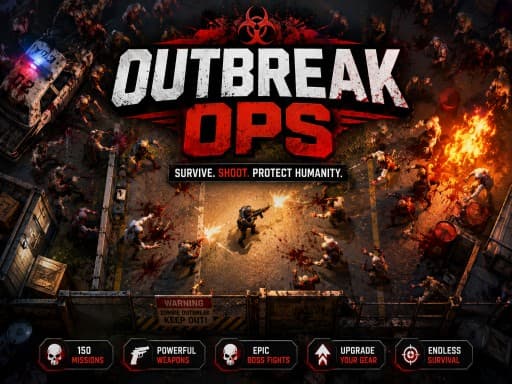
Outbreak Ops is a top-down zombie shooter built around mission-based progression across 15 levels. You move through environments like abandoned compounds, dark bunkers, and military labs, clearing infected hordes to complete objectives. The core loop is familiar—move, aim, shoot, survive—but the mission structure gives it more direction than typical wave-based survival games. Progression is tied to coins earned during missions. You spend these to unlock and upgrade weapons across a decent roster: pistols, shotguns, SMGs, sniper rifles, flamethrowers, and miniguns. A typical mission runs 5-8 minutes depending on difficulty, making this a solid option for shorter play sessions. Each mission ends with escalating zombie waves, and boss encounters break up the pacing with enemies that have distinct attack patterns requiring specific strategies. The game appeals most to players who want straightforward zombie shooting with light progression systems. The top-down perspective keeps spatial awareness manageable, and the weapon variety gives you reason to experiment. Just don't expect narrative depth—the setup is window dressing for the action.
If you need a break from zombie waves, Ball Roll offers a different pace with puzzle-based challenges.
Each mission drops you into a quarantine zone with a clear objective—usually eliminating all hostiles or surviving a set number of waves. You'll start with basic loadout and pick up coins from fallen enemies. Movement is constant: you kite zombie groups, create chokepoints with grenades, and manage ammo reserves carefully. The difficulty curve ramps noticeably around mission 5, where faster enemy types appear and ammo management becomes a real concern. Boss encounters require patience—each boss telegraphs attacks for roughly 1.5 seconds before striking, giving you a window to dash clear with Shift. One frustration during testing: the grenade cooldown is unusually punishing in early missions before upgrades. Getting swarmed with no grenade available led to several cheap deaths. Once coin income stabilizes around mission 4-5, you can invest in grenade capacity upgrades that smooth this out. The reload mechanic on R creates deliberate vulnerability windows—enemies don't slow down while you reload, so timing your reloads during brief gaps in the action is critical to survival.
For something lighter between missions, Long Leg Master provides arcade-style distraction with simple mechanics.
15 missions across varied environments—bunkers, streets, labs—each taking roughly 5-8 minutes to complete
6 weapon types (pistols, shotguns, SMGs, sniper rifles, flamethrowers, miniguns) with individual upgrade paths
Boss zombies with unique attack patterns appearing every 3-4 missions
Coin-based progression system requiring 3-4 mission completions to afford mid-tier weapon upgrades
Dash mechanic on Shift with a 2-second cooldown—critical for surviving boss telegraphed attacks
Grenade system with limited starting capacity (2 charges), upgradeable through the shop
Wave-based difficulty scaling that introduces faster enemy types around mission 5
Invest early coin income in shotgun upgrades—the spread damage handles crowds efficiently through mission 6
Tested dash timing repeatedly: the i-frame window lasts roughly 0.4 seconds, enough to dodge through a single attack but not sustained damage
Common beginner mistake: reloading with R while standing still. Always reposition during reload animations—zombies won't wait for you
Grenade cooldown prevents spam, so save them for wave transitions when 8+ enemies cluster in chokepoints
Boss patterns repeat every 15-20 seconds; learn the cycle and attack during recovery frames only
Flamethrower damage-over-time stacks, making it efficient against high-HP enemies despite its short range
Players who enjoy the zombie theme but want strategic depth should try Zombie Protocol for a tactics-focused experience.
Common questions about Outbreak Ops
A full clear takes roughly 2-3 hours depending on skill and upgrade progression. Some missions require grinding earlier levels for coins to afford necessary weapon upgrades, which adds playtime.
The current build doesn't offer a respec option. Coin investments in weapon upgrades are permanent, so test weapons carefully before committing large amounts of currency.
Tested on a mid-range desktop with integrated graphics—the game maintained roughly 30-45 FPS during heavy wave sequences with 20+ enemies on screen. Frame drops occurred during boss fights with particle-heavy attacks, particularly flamethrower usage.
Each weapon has distinct behavior. Shotguns have spread and falloff. Sniper rifles have slow fire rates but pierce multiple enemies. The flamethrower applies damage-over-time ticks. These differences matter when choosing loadouts for specific mission types.
Progress saves automatically between missions. Weapon upgrades and coin totals persist, but you'll restart from the mission select screen when returning. No manual save slots exist.
Boss encounters are mandatory story gates every 3-4 missions. You cannot progress to later levels without defeating them. Each boss requires specific strategies—head-on aggression usually fails.
Last reviewed: May 2026 / Reviewed by Shawn
Tested across 3 sessions: Outbreak Ops delivers solid dual-stick shooting and boss variety, but rough wave balancing holds it back from greatness.
Outbreak Ops stands out for its mission structure and weapon variety. Most browser-based zombie shooters rely on endless wave survival with little progression. Here, the 15-mission campaign gives you concrete goals, and the weapon upgrade system provides meaningful reasons to replay earlier levels for additional coins. The flamethrower and minigun feel meaningfully different from standard ballistic weapons—each changes your approach to crowd control. The boss encounters, while not perfectly balanced, demand more thought than simply holding down the fire button. The main drawback is inconsistent wave balancing. Late missions spike in difficulty without clear warning, and the coin economy feels sluggish in early hours. Compared to similar top-down shooters in the browser space, Outbreak Ops offers more structure but less polish. If you've played something like Crimsonland, expect a rougher but more progression-heavy experience.