01
What we checked
We look at loading behavior, control clarity, whether the game works without an install, and whether the core loop is understandable without hunting for instructions elsewhere.
Loading...
Speed Slope Review: Neon Ball Runner That Hooks You In Under 2 Minutes
Speed Slope drops you straight into neon chaos—rolling ball, sharp turns, moving obstacles everywhere. Fif here: this one actually delivers fast. Full breakdown inside.
Speed Slope is listed in our Arcade collection because it passed a basic playability review: it loads in a modern browser, explains itself quickly, and offers a clear reason to keep playing after the first attempt.
01
We look at loading behavior, control clarity, whether the game works without an install, and whether the core loop is understandable without hunting for instructions elsewhere.
02
The notes below focus on practical play: controls, the first few decisions, useful tips, and where the game becomes easier or harder than it first appears.
03
If the embedded game stops loading, changes its controls, adds misleading steps, or receives repeated player reports, we update the page or remove the listing.
No listed keybindings, which tells you everything: this runs on pure instinct. Arrow keys or A/D steer the ball left and right—that's your whole toolkit. No jump button, no brake, just momentum and reflexes. Honestly? That simplicity works in its favor. You're not memorizing combos, you're just reacting. The ball physics feel weighty but responsive, which matters when you're threading between obstacles at full speed.
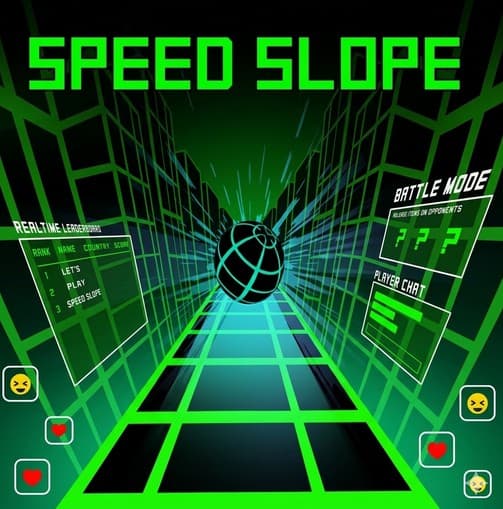
So you're staring at a glowing neon track and a ball that's already rolling whether you're ready or not. That's Speed Slope—an endless arcade runner where the floor literally falls out from under you if you slow down. The whole pitch is right there in the name: maintain speed, survive the slope, don't fall into the void. The aesthetic hits that classic synthwave-neon vibe without trying too hard. Think geometric shapes, electric blues and hot pinks, tracks that twist in ways that shouldn't be physically possible. It's not groundbreaking visually, but it's clean and readable—which matters when stuff's flying at you. This is for people who want instant gratification from their browser games. No tutorials, no story setup, no character customization menus. You click play and you're already dodging. If you liked Slope or similar ball runners back in the day, this scratches that same itch but with some fresh obstacle patterns.
If you want to switch from reflex-based running to precision aiming, offers that same quick-session energy.
A round starts and within three seconds you're already committed—the ball accelerates automatically and the track begins its descent. Your first run will last maybe 20 seconds if you're lucky. Second run? Maybe 40. That's the loop. Here's the moment that got me: around my fifth attempt, I hit this sequence where the track narrowed while these red barriers slid across my path in rhythm. I didn't think, I just weaved through it, and when I cleared it my brain went okay this is actually fire. That's when the hook landed. But real talk—the thing that almost made me rage-quit was around minute eight. The speed ramps up significantly and suddenly the camera feels like it's struggling to keep up with your ball. You'll die to things you couldn't reasonably react to, and that feels cheap. Push past it though, and there's actual skill expression once you learn the visual cues.
Fans of the neon aesthetic and fast-paced dodging in Speed Slope should check out for a similar vibe.
Endless procedurally-generated tracks mean no two runs feel identical—you can't memorize patterns
Progressive difficulty that actually scales instead of staying safe and boring forever
Neon visual style that keeps obstacles visible even during chaotic sections
Zero load time between respawns—you're back running in under a second
Speed multiplier system that rewards risk-taking and clean runs through tight spots
Moving obstacle types that force you to read ahead instead of just reacting
Leaderboard integration if you're the type who needs to prove something to strangers
Stay near the center of the track by default—edges are death when unexpected turns appear
Don't overcorrect on narrow sections; small taps beat jerky movements every time
Watch for color changes in the track ahead—they often signal upcoming hazards before you can see them clearly
Your ball has slight momentum drift—account for it when changing directions quickly
Wish I knew this sooner: the speed ramps are predictable after you've seen them once per session, so dying to the same spot twice is on you
Take micro-breaks between runs if you're tilting—angry hands make sloppy movements
Need something a little more chill after the intensity? keeps the arcade feel but at a more relaxed pace.
Common questions about Speed Slope
Individual runs go anywhere from 10 seconds to a few minutes depending on skill. Most people play 15-30 minutes total before moving on.
Pure score-chasing survival. Distance traveled plus points from clean obstacle dodges. No story mode, no levels to unlock.
If you want zero friction and immediate action, yes. If you want depth and progression systems, look elsewhere—it's honest about being a quick arcade hit.
Intentional design choice to increase tension, but yeah it can feel disorienting. Adjusts after a few sessions once you adapt to the visual language.
Nope—procedural generation means every run is unique. You're building general skills, not memorizing layouts.
Last reviewed: May 2026 / Reviewed by Fif
Speed Slope drops you straight into neon chaos—rolling ball, sharp turns, moving obstacles everywhere. Fif here: this one actually delivers fast. Full breakdown inside.
Look, there are a thousand ball-rolling endless runners out there. Speed Slope earns its spot because it respects your time—the hook arrives fast, the feedback loop is tight, and you know within two minutes if this is your thing or not. No wasting 20 minutes on tutorials before the real game starts. The trade-off? It won't blow your mind with innovation. This is a refined take on an existing formula, not a genre reinvention. Some of the later obstacle placements feel unfair rather than challenging. But for a quick browser session during a study break or between meetings? It's solid. Fif's verdict: fun for 30-45 minutes, then you've seen what it's offering. That's enough.