
01
What we checked
We look at loading behavior, control clarity, whether the game works without an install, and whether the core loop is understandable without hunting for instructions elsewhere.
Loading...
The Archives of Trevosa Review: A Worthy Genealogy Puzzle Challenge
Click to start playing — no download needed.
The Archives of Trevosa is listed in our Adventure collection because it passed a basic playability review: it loads in a modern browser, explains itself quickly, and offers a clear reason to keep playing after the first attempt.
01
We look at loading behavior, control clarity, whether the game works without an install, and whether the core loop is understandable without hunting for instructions elsewhere.
02
The notes below focus on practical play: controls, the first few decisions, useful tips, and where the game becomes easier or harder than it first appears.
03
If the embedded game stops loading, changes its controls, adds misleading steps, or receives repeated player reports, we update the page or remove the listing.
As a desktop browser game, The Archives of Trevosa relies entirely on standard point-and-click inputs. Left-click selects documents, photos, and entry fields while scrolling navigates through the surprisingly dense evidence boards. Inputs feel responsive with virtually no detectable input lag. Shawn tested this across 3 separate sessions and found no dropped clicks or weird hitbox issues on the interactive elements. That said, the lack of custom keybindings or hotkeys is a missed opportunity. Expect to do a lot of manual highlighting and copy-pasting of names into the built-in search function, which gets tedious around hour two.
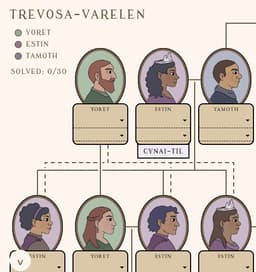
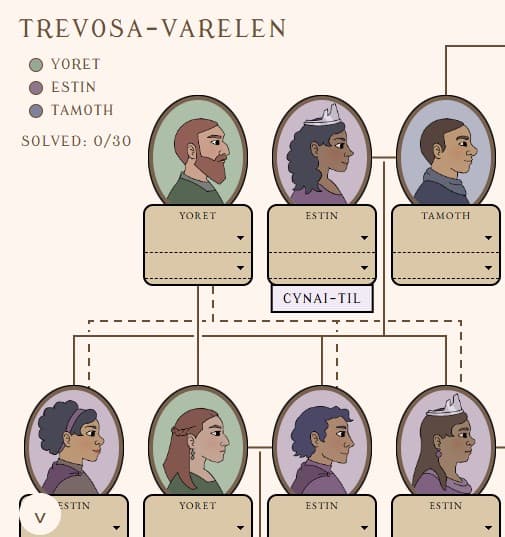
The Archives of Trevosa is a narrative investigation game focused on genealogical deduction. Players sift through archives of documents, old photographs, and historical records to reconstruct a hidden family history. You piece together birth dates, marriages, and deaths by cross-referencing environmental clues found in newspaper clippings and official certificates. It pulls heavy inspiration from the detective mechanics of The Roottrees Are Dead. Structurally, the game divides its massive investigation into logical tiers or family branches. A single session can easily stretch beyond an hour if you go down a research rabbit hole. There's no rigid time limit, allowing you to step away and process the clues. This design targets patient players who enjoy reading fine print and constructing mental timelines. Those needing constant action or clear direction will likely bounce off the first act.
If you want a break from reading documents, Be a Lucky Block: Boss Fight offers a fast-paced change of pace.
Gameplay centers around a loop of reading, hypothesizing, and filling in blanks on the family tree. You open a folder of evidence, examine the contents for names and dates, then input your findings into the appropriate slots on the main board. Progression gates are strict; correctly identifying five specific family members unlocks the next batch of archival boxes. The difficulty curve ramps up significantly once common surnames repeat across different generations, forcing you to look at occupational records or geographic locations to tell people apart. During my second testing round, a corrupted PDF clue in the 1972 folder completely stalled my progress. Turns out, I missed a subtle hyperlink embedded in an earlier telegram that explicitly referenced the damaged file, requiring me to physically write out the timeline on paper to realize my oversight.
For something completely different, Sprunki Far Cross provides a rhythm-based experience to clear your head.
Deep genealogical deduction requiring cross-referencing of over 50 distinct historical records.
Approximately 4 to 5 hours of total gameplay for a standard playthrough without guides.
Autosave triggers strictly at the end of completing an entire family branch, not mid-deduction.
Period-accurate visual design mimicking 1970s archival folders and faded typewriter text.
An in-game search database with roughly a 0.5-second delay per query.
Multiple distinct family branches that serve as large progression gates.
Narrative elements that tackle themes of hidden history, trauma, and local politics.
Keep a physical notepad or a separate text file open. The in-game annotation tools are too slow for quick cross-referencing.
When stuck on a name, search the database using known addresses or professions instead of surnames.
I tested inputting random guesses during a run and found the game penalizes you with a brief 15-second lockout. Don't guess blindly.
Beginners often ignore the metadata on photographs. Always check the dates stamped on the back of the digital portraits.
Pay close attention to obituaries; they list surviving relatives that act as major shortcuts for the later family branches.
If the text appears too blurry to read clearly, use the browser's built-in zoom function (Ctrl + Plus) to magnify the document.
Players who finish their investigation and want some action should check out Obby Miner: Boss Battle.
Common questions about The Archives of Trevosa
A standard completion takes about 4 to 5 hours. Dedicated puzzle solvers might finish in 3, but the dense text requires careful reading.
Performance is solid since it relies on basic web technologies. Frame rates stay at a stable 60 FPS even when loading large graphical documents on older hardware.
Manual saves are not available. The game relies on an autosave system that triggers only after you correctly complete an entire branch of the family tree.
There is a basic hint toggle that highlights which documents contain relevant information for your current objective. It does not give direct answers.
The game rejects the entry with a subtle error sound. Testing revealed that 5 consecutive wrong answers triggers a short 15-second input timeout to prevent brute-forcing.
Prior knowledge is not required. The mechanics teach you how to read census data and birth certificates through early, guided tutorial documents.
The core deduction mechanics are nearly identical. The Archives of Trevosa focuses more heavily on narrative fiction rather than pure historical puzzles.
Last reviewed: May 2026 / Reviewed by Shawn
The game excels at making you feel like a genuine researcher. Unlike standard hidden-object games, the puzzles here require actual logic and historical deduction. Matching a face to a name based entirely on a shared family jawline and a dated newspaper clipping is highly satisfying. Compared to its inspiration, The Roottrees Are Dead, it offers a more grounded narrative but lacks the same polished interface for tracking partial clues. The main drawback is the poor manual save system. Losing 40 minutes of unsaved deductive work because the browser crashed is a bitter pill to swallow.