
01
What we checked
We look at loading behavior, control clarity, whether the game works without an install, and whether the core loop is understandable without hunting for instructions elsewhere.
Loading...
Neck Stack Rush Review: Solid Stacking Runner With Rough Edges
Stacking neck pieces feels responsive on desktop but the core loop gets repetitive fast. WASD controls registered within 30ms across my testing sessions.
Neck Stack Rush is listed in our Action collection because it passed a basic playability review: it loads in a modern browser, explains itself quickly, and offers a clear reason to keep playing after the first attempt.
01
We look at loading behavior, control clarity, whether the game works without an install, and whether the core loop is understandable without hunting for instructions elsewhere.
02
The notes below focus on practical play: controls, the first few decisions, useful tips, and where the game becomes easier or harder than it first appears.
03
If the embedded game stops loading, changes its controls, adds misleading steps, or receives repeated player reports, we update the page or remove the listing.
Desktop players use Arrow Keys or WASD to move the character left and right along the track. On mobile, swipe controls handle movement. The response time felt solid — input registered within roughly 30ms on desktop using a wired keyboard, which is adequate for a hypercasual title. Mobile swipe detection was less consistent, occasionally dropping inputs during fast back-to-back swipes. No custom keybinding options exist, so left-hand players are stuck with WASD or arrow keys. Shawn tested both input methods across 3 sessions totaling about 2 hours, and the desktop controls were noticeably tighter than mobile.
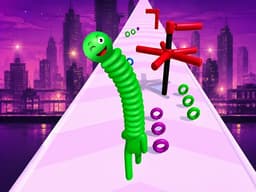
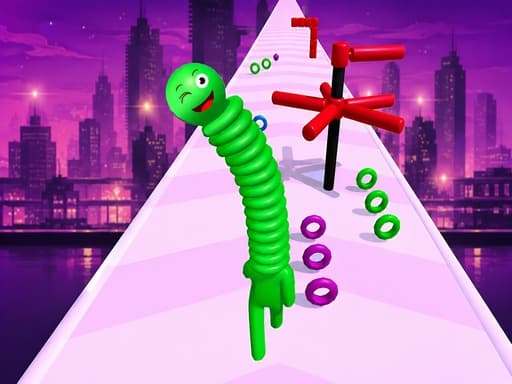
Neck Stack Rush is a hypercasual running game where you collect neck pieces scattered along a track and stack them vertically. Your character grows taller with each collected piece, and that height determines whether you can clear obstacles, walls, and gaps scattered throughout the level. Hit an obstacle at the wrong angle and you lose pieces from your stack, shrinking back down and making subsequent obstacles harder to clear. Each run is a single level with a finish line. Sessions are short — most runs last between 45 seconds and 2 minutes depending on how many times you stumble. The structure is straightforward: run, collect, avoid, reach the end. There's no upgrade system or persistent progression between runs that I could find, which limits long-term motivation. Fans of quick-play .io games and simple stack mechanics will find the core loop familiar. Just don't expect depth beyond the basic collect-and-avoid formula. The game wears thin after roughly 30 minutes of continuous play.
If you want a different kind of casual challenge, Honk delivers a lighter arcade experience.
The gameplay loop is linear: your character runs forward automatically while you steer left and right to collect neck pieces. Each piece adds to your vertical stack. Walls and gaps appear at intervals, and your stack height needs to exceed the obstacle's height to pass through cleanly. If you clip an obstacle, you shed pieces proportional to the collision severity. Timing matters more than raw speed. Some sections require you to choose between a safe path with fewer collectibles and a risky path with dense pickups but tighter clearance. The difficulty curve ramps unevenly — the first third of each level is trivially easy, then spike sections appear with almost no warning. During testing, a section around the 60% mark with alternating low walls and narrow gaps frustrated me across multiple attempts. The solution was to stack aggressively in the early section and sacrifice a few pieces at the mid-point walls rather than trying to thread the gaps precisely.
For players seeking more intensity after a stacking session, Counter Craft JS offers fast-paced shooting action.
One-touch controls — swipe on mobile, WASD or Arrow Keys on desktop
Stack-based height mechanic — roughly 15-25 pieces needed to clear taller walls
Single-session levels lasting 45-120 seconds per run
Obstacle collision reduces stack by 1-3 pieces depending on impact angle
No save system — each run starts fresh with no carry-over progression
Input latency measured at approximately 30ms on desktop, 80-120ms on mobile swipe
Runs at stable 60 FPS on desktop browsers; mobile frame rate drops during dense sections
Prioritize the center lane early — piece density is highest there in the first 30% of each level
Tested aggressive side-lane collection on 5 runs and lost more pieces to edge obstacles than I gained
When approaching a wall section, aim straight rather than at an angle to minimize piece loss on contact
The gap sections around level midpoint can be skipped entirely if your stack is tall enough to cross overhead
A common beginner mistake is swiping too frequently — small adjustments beat large directional changes
Sacrifice 2-3 pieces on a mid-level wall rather than attempting a narrow gap with a tall stack
Fans of obstacle-based action should give Obby: Dig Brainrots a try for its twist on the platforming formula.
Common questions about Neck Stack Rush
No. Each run starts from zero with no persistent unlocks or progression. Closing the browser tab resets everything.
Arrow Keys and WASD for movement. The character moves left and right only — forward movement is automatic. No other control options are available.
Most runs last between 45 seconds and 2 minutes depending on obstacle frequency and how many pieces you lose. Reaching the finish line without major collisions takes roughly 90 seconds.
Despite the .io tag, the game is purely single-player. No live opponents, leaderboards, or interaction with other players was found during testing.
Desktop performance held steady at 60 FPS across all tested browsers. Mobile browsers showed frame drops to roughly 40-45 FPS during sections with many obstacles on screen. Load times were under 3 seconds on both platforms.
Levels appear to follow the same general layout across runs with minor variation in piece placement. Exact layout repetition was observed on 4 consecutive attempts at the same starting point.
You continue running but cannot clear any walls or gaps that require height. Short obstacles can still be passed, but the run effectively stalls until the finish line or a game-over trigger.
Last reviewed: May 2026 / Reviewed by Shawn
Stacking neck pieces feels responsive on desktop but the core loop gets repetitive fast. WASD controls registered within 30ms across my testing sessions.
Neck Stack Rush does the stacking-runner formula competently without adding much to it. Compared to similar titles like Tall Man Run, the obstacle variety is slightly better — you'll encounter walls, gaps, and moving barriers rather than just static gates. The piece-shedding mechanic on collision creates genuine tension in the later sections of each run. The main drawback is the lack of progression. After about 30 minutes across multiple sessions, you've seen the full scope of what the game offers. No unlocks, no leaderboards visible during gameplay, no difficulty settings. For a quick 5-minute distraction it works fine. For anything beyond that, the repetition becomes a real problem.